
Computer Science Concepts: Sybil Attacks
Computer science is full of elegant ideas that shape the software we use every day. Most people have heard terms like encryption, compression, or machine learning. Others are just as important but rarely escape engineering or information security circles.
This is the first in an occasional series exploring those lesser-known concepts, not as academic theory, but through practical examples of how they solve real engineering problems.
We’ll start with one that has quietly become more important in the age of AI. As software makes it increasingly easy to create, manage, and coordinate large numbers of convincing online identities, understanding the Sybil Attack has never been more relevant.
One Person Pretending to Be Hundreds
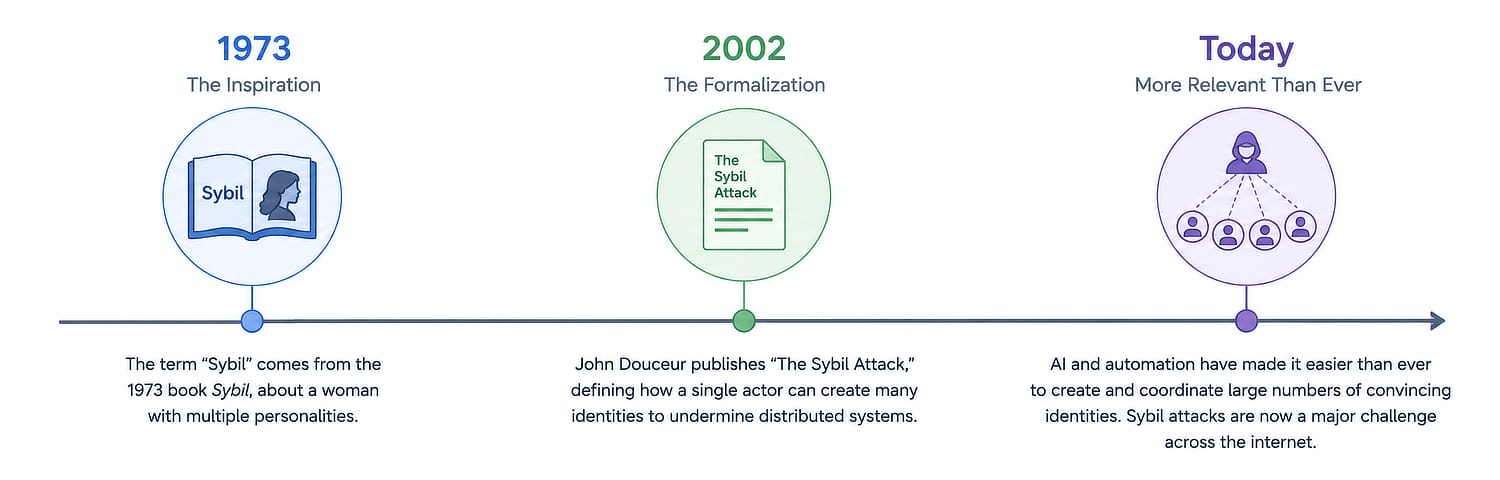
The name comes from the 1973 book Sybil, whose subject was portrayed as having multiple personalities. The analogy is direct: one entity presents itself as many independent identities.
John Douceur introduced the term to computer science in his 2002 paper, "The Sybil Attack."1 The paper examined how a single participant could create many identities and use them to gain more influence than the system intended. Brian Zill of Microsoft Research suggested the name. Earlier work had called the problem pseudospoofing, but Sybil attack is the term that endured.
Today, the same basic technique appears in many forms. Someone might create hundreds of accounts to:
- Leave fake five-star product reviews.
- Vote repeatedly in an online poll.
- Claim referral bonuses.
- Trigger blocklisting of IPs or sites.
- Purchase limited-release products.
- Circumvent account restrictions.

The system sees many participants, yet the attacker controls all of them. AI-assisted software does not create this problem, but it has significantly lowered the effort required to produce and coordinate accounts that look plausible.
A Fictional Product
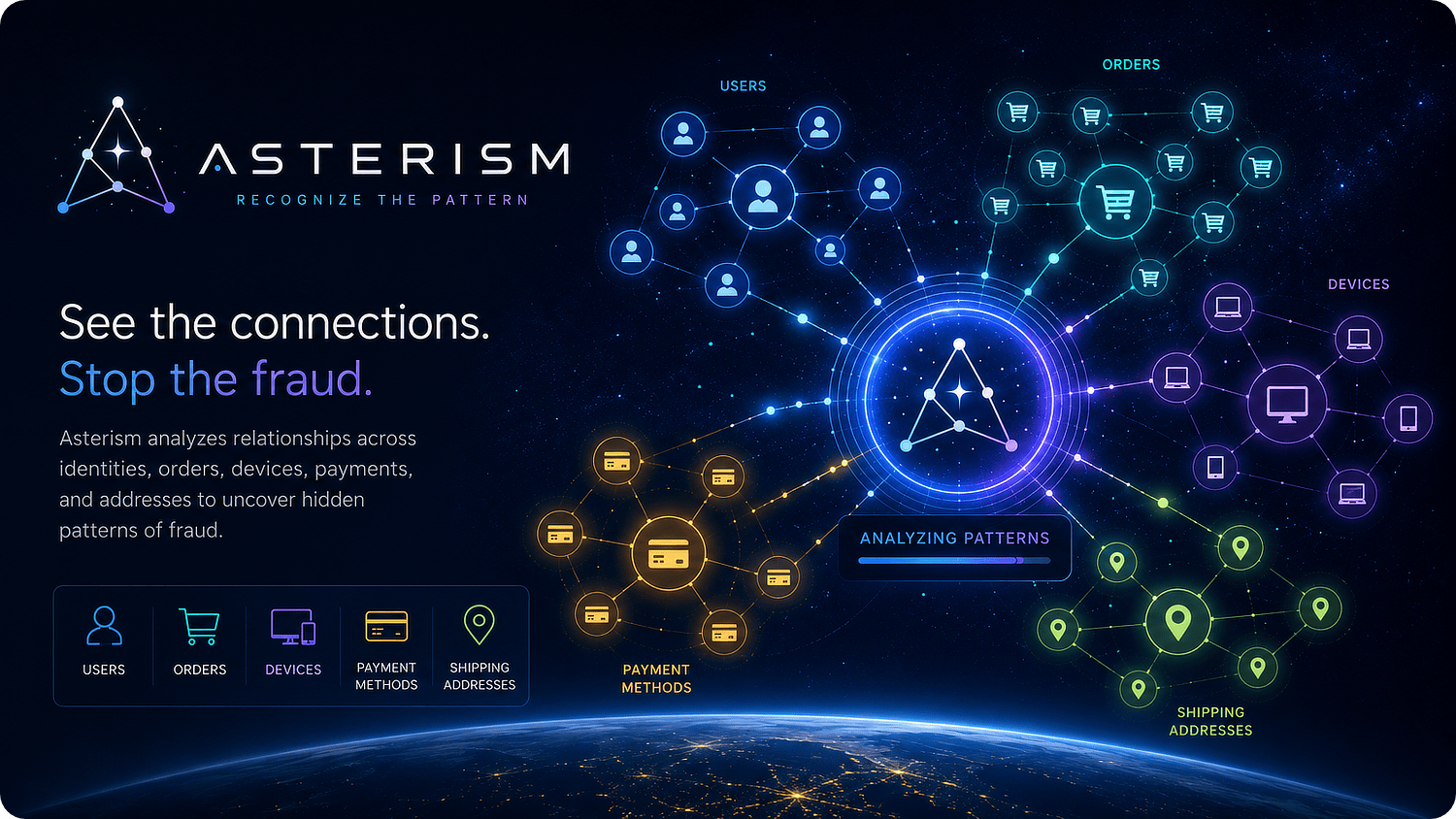
Imagine that we have been asked to design a fraud detection platform for an ecommerce company. We’ll call it Asterism, an astronomy term for a recognizable pattern of stars.
Rather than jumping directly to the final design, we’ll build Asterism the same way many real systems evolve: starting with a straightforward rule-based fraud detector, improving it incrementally, and eventually building functionality that also considers relationships among accounts.
The distinction matters: a group of related fraudulent orders is not automatically a Sybil attack. The Sybil element appears when those accounts exploit the assumption that each account represents an independent customer. Graph analysis can also uncover fraud rings that do not meet that definition.
Asterism Version 1: Traditional Fraud Detection
Our first version looks much like many fraud systems today. Every incoming order receives a risk score based on signals like:
- IP reputation
- Payment verification
- Billing address consistency
- Disposable email providers
- Velocity checks
- Geographic anomalies
- CAPTCHA score
If the score exceeds a threshold, Asterism sends the order for review.
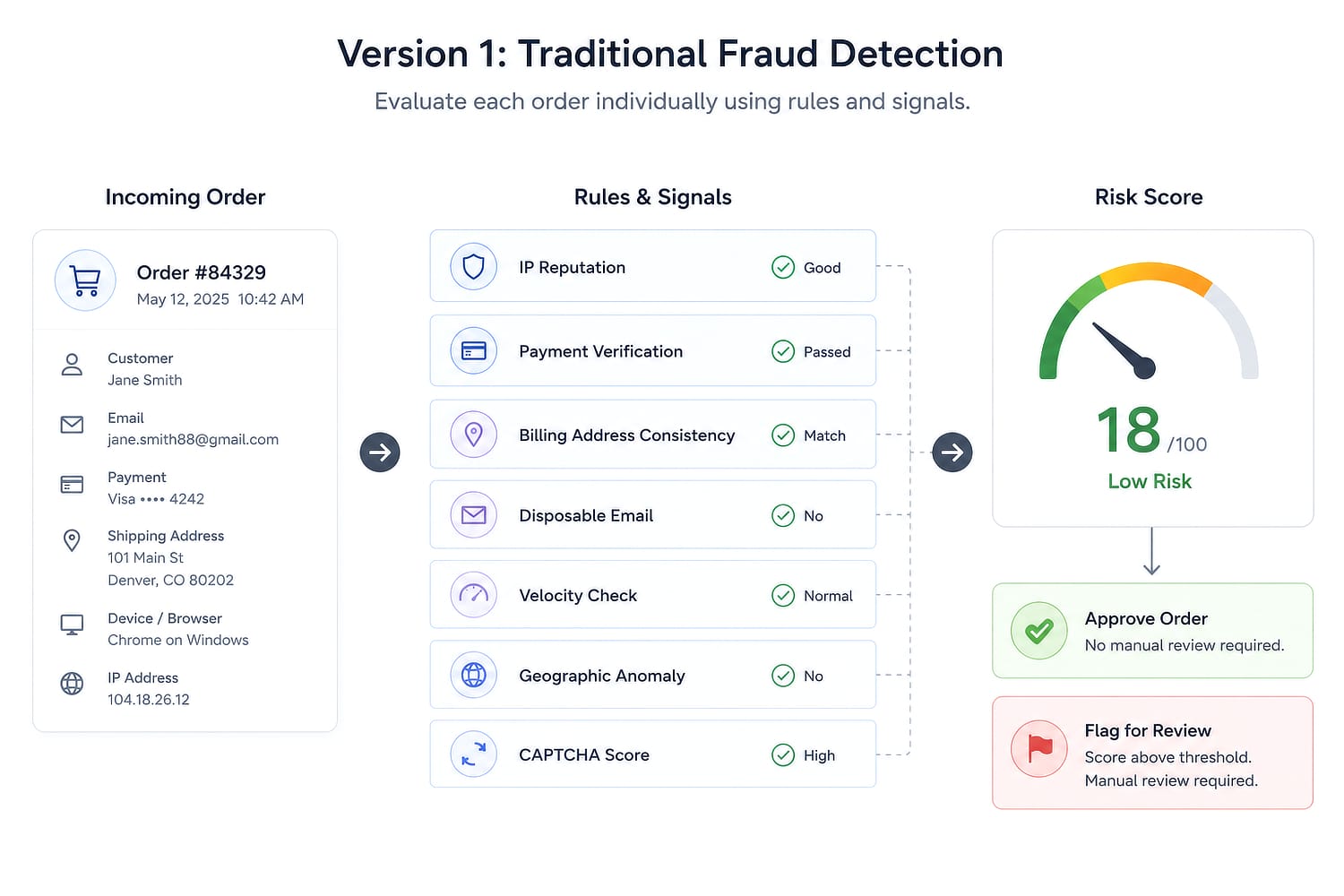
It's a reasonable, albeit simplistic, design. It worked well when using an ecommerce site required more human effort and automation was comparatively expensive.
Like many areas of technology, however, attackers adapt. New tools emerge and automation becomes cheaper. An attacker can create accounts with different names, email addresses, payment methods, and other surface details, then keep the activity of each account below the thresholds intended to catch suspicious behavior.
Suppose one operator places 200 orders through 200 accounts. The fraud itself might involve stolen payment cards, referral abuse, or evading a one-per-customer limit. Each order may look ordinary when evaluated alone because the system grants every account the benefit of being unrelated to the others.
Asterism Version 1.5: Stronger Individual Signals
The usual response is to improve the existing detector. Asterism can add more fraud rules, stronger browser fingerprinting, device reputation, behavioral signals, and machine learning models. Those improvements are valuable because they raise the cost of making each account look legitimate.
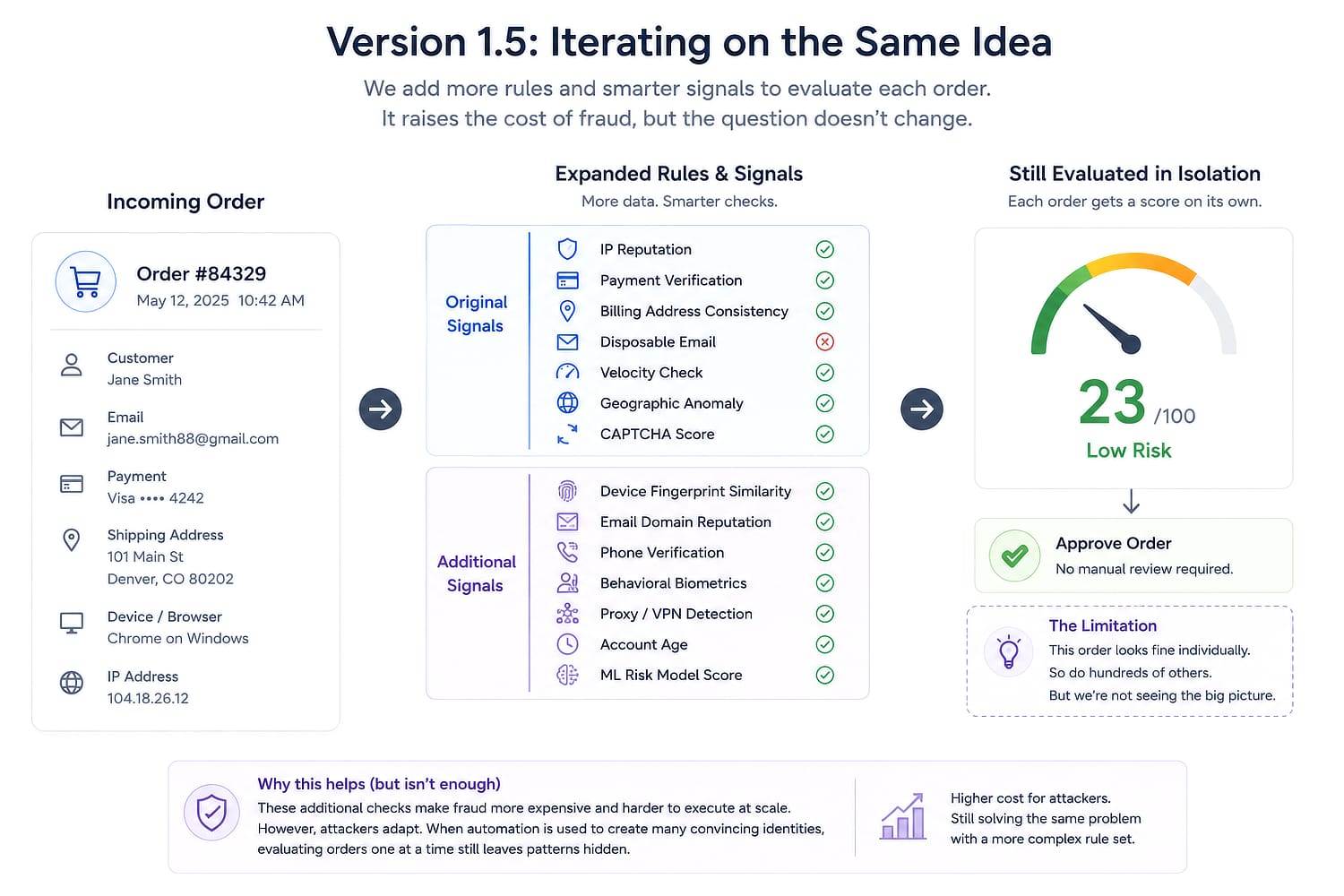
They do not, however, answer whether separate transactions are connected. The system is still judging each order primarily on its own. Better individual signals and relationship analysis solve different parts of the problem, so Asterism will ultimately need both.
Asterism Version 2: Adding Relationships
Instead of asking only:
Is this order fraudulent?
Asterism adds a second question:
Is this order related to other orders?
That question changes the framing of the analysis from one transaction to a network of entities.
Imagine drawing every customer as a dot on a whiteboard. When two customers share a device, payment method, shipping address, or browser fingerprint, draw a line between them. A small diagram may look like a tangle of dots and lines. As the network grows, structures that are difficult to notice in a table become easier to measure.
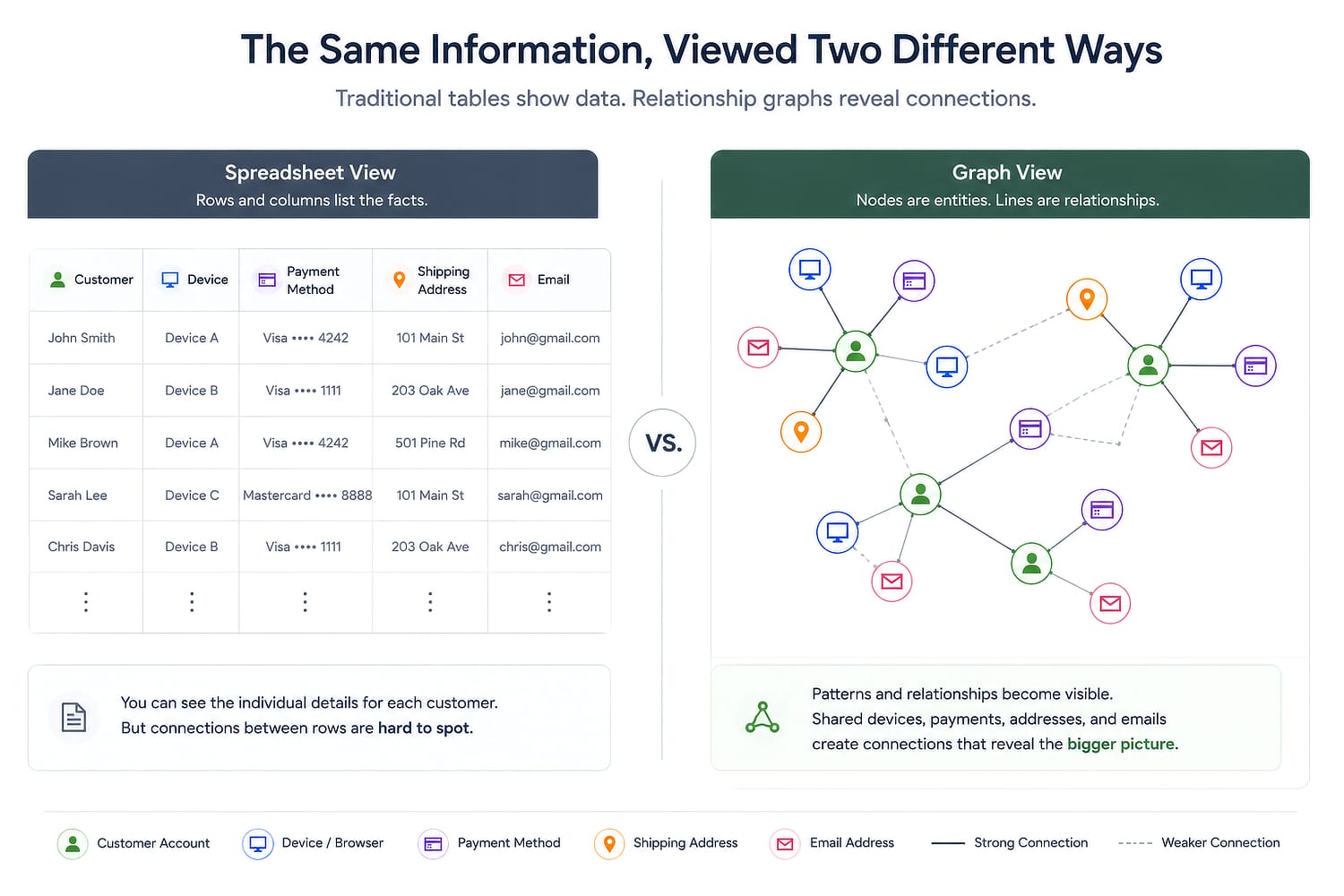
Computer science calls this structure a graph. A graph represents things and the connections between them. Each thing is a node, whether it's an order, account, device, payment card, address, or something else. A connection between two nodes is an edge. One order connects to an account. That account connects to a browser fingerprint. The fingerprint connects to another account, which connects to another order, and so on.
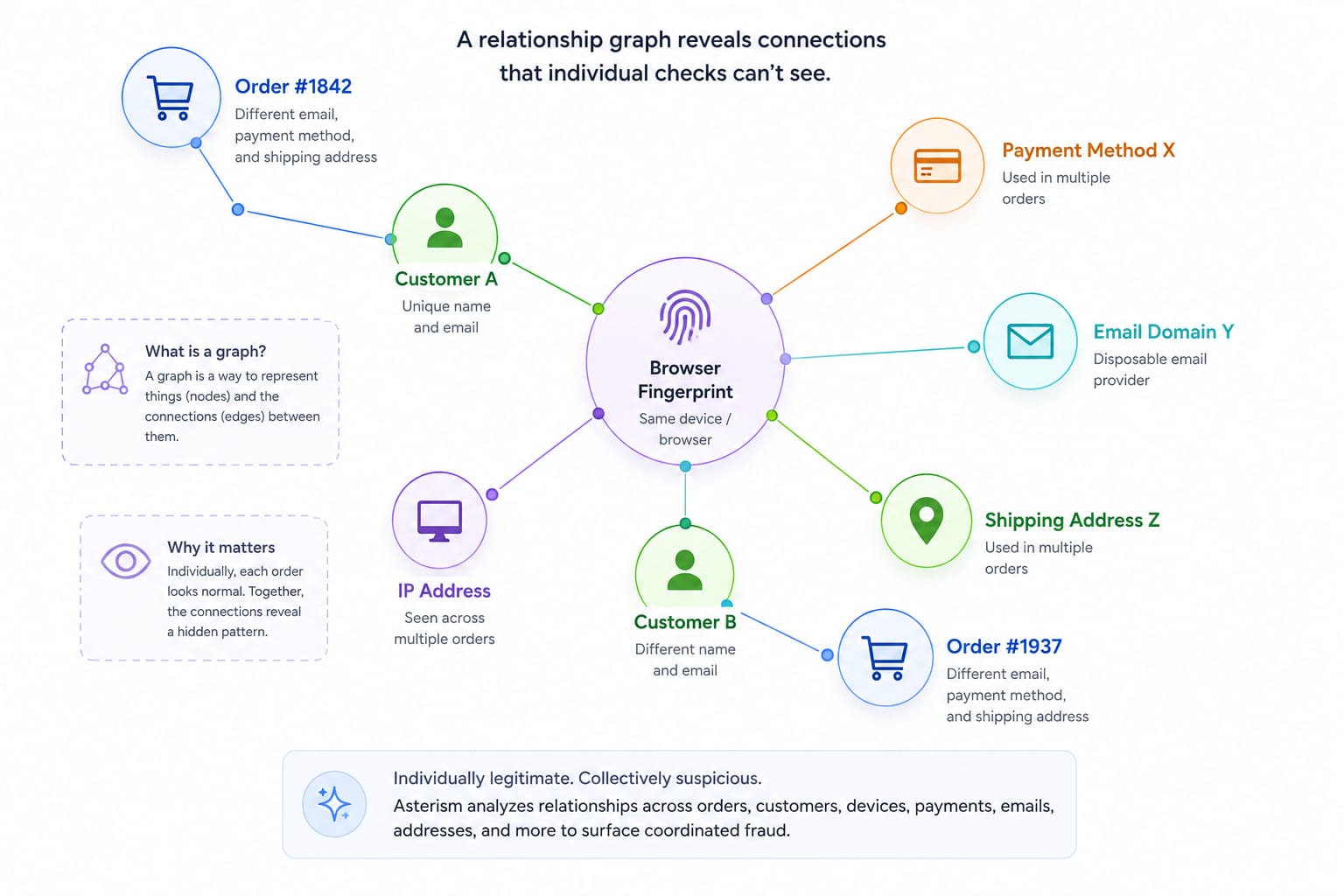
The graph can expose patterns such as:
- A browser fingerprint shared across dozens of supposedly unrelated customers.
- Several accounts purchasing identical products within seconds.
- Shipping addresses concentrated in neighboring apartments.
- Accounts created minutes apart that reuse the same small set of infrastructure.
No single observation proves fraud. Together, they identify a cluster worth investigating.
An open system cannot assume that every account belongs to a different person or that every review represents an independent opinion. Those claims are cheap to make and difficult to verify. A relationship graph gives Asterism evidence for estimating how much confidence to place in them.
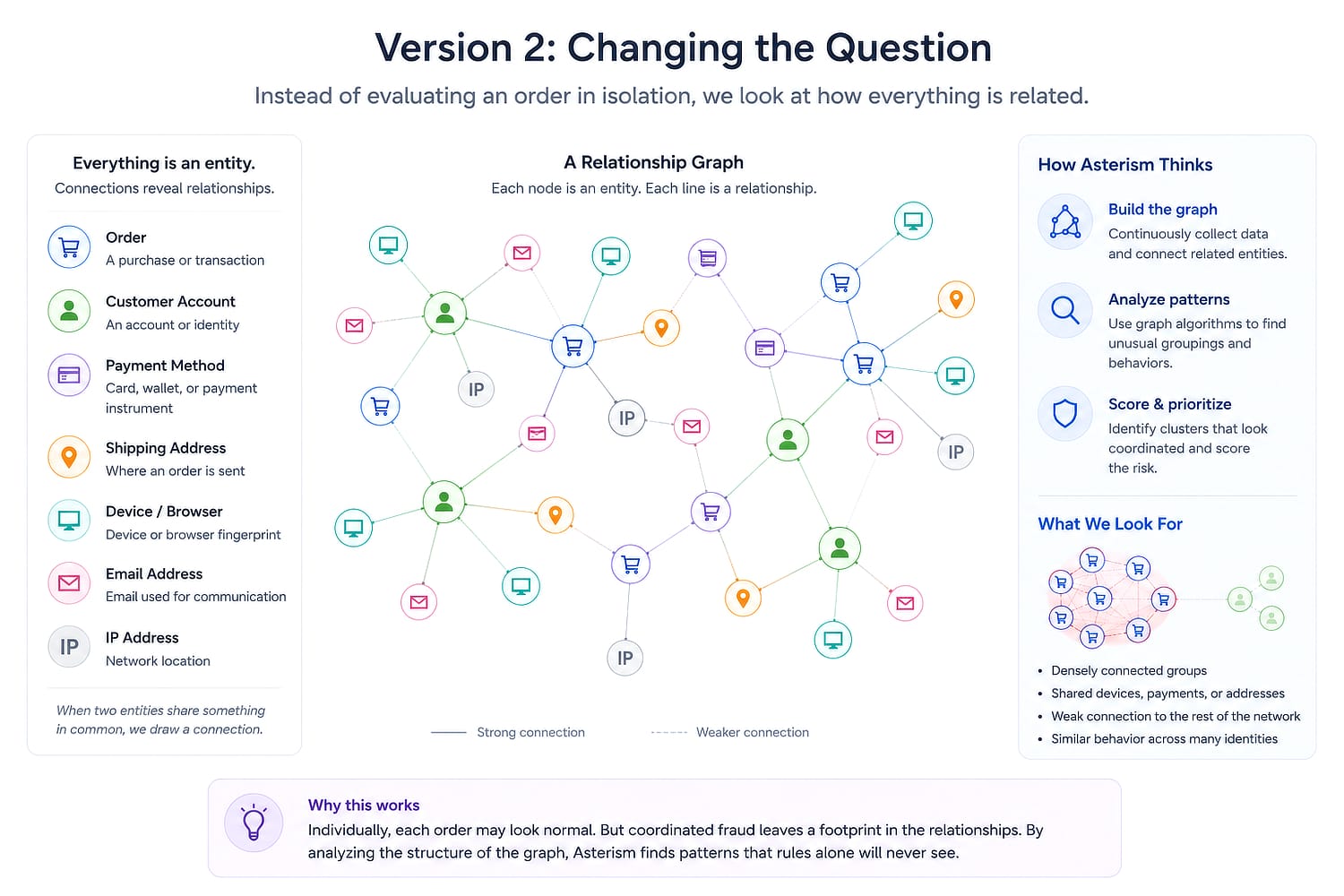
Version 2 does not discard the transaction-level detector. It adds group context. Asterism can still flag a suspicious order while also identifying clusters of related identities and prioritizing them for investigation.
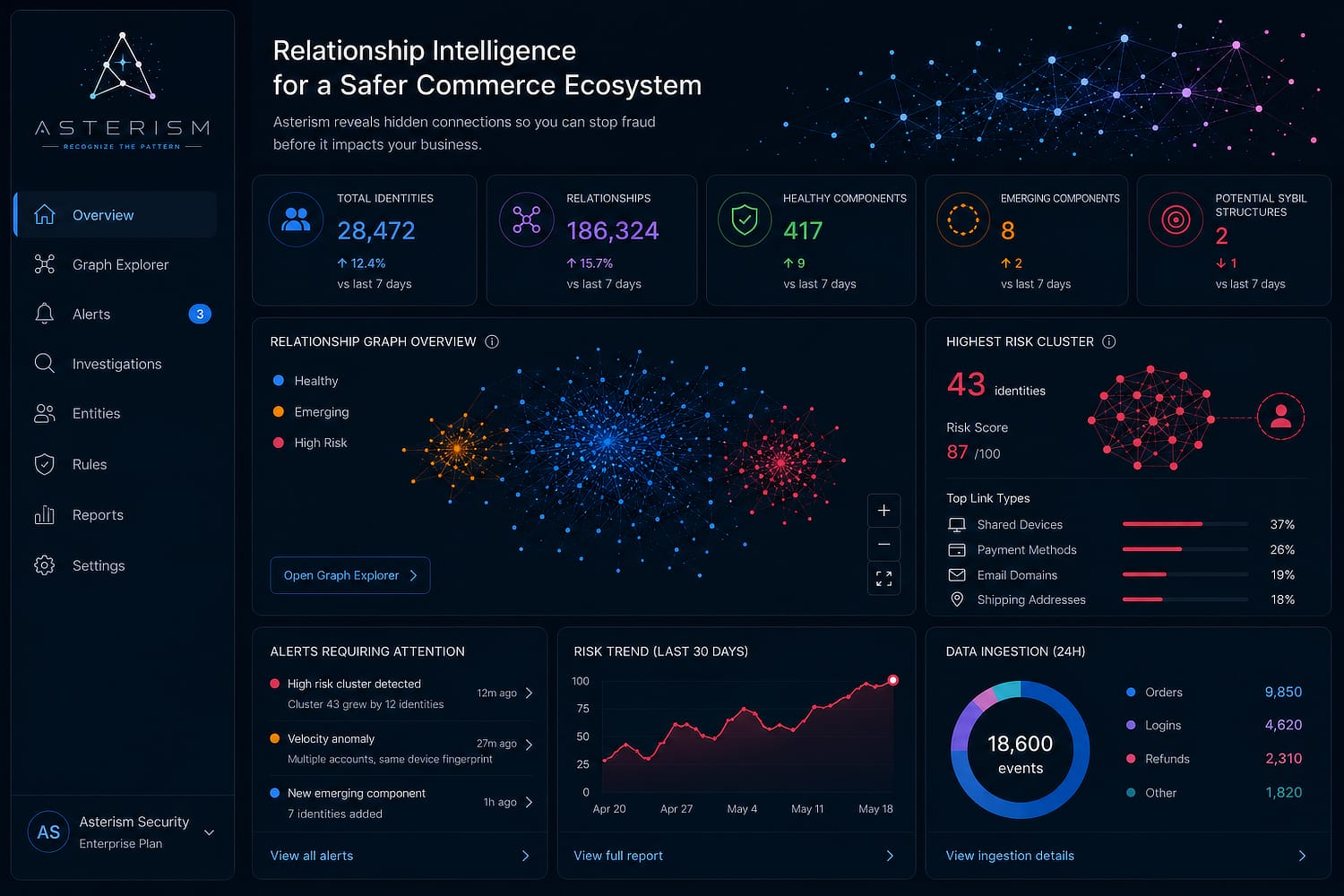
A dashboard for such a system might look like this:
From Connections to Anti-Sybil Grouping
Building a graph describes how accounts, orders, devices, payment methods, and addresses are related. The next step is deciding which relationships are meaningful.
A shared device can indicate coordinated accounts, but it can also represent a family computer. An office may put hundreds of legitimate customers behind one IP address. A payment provider or common email domain can connect people who have never met. Edge quality matters as much as the number of edges.
Classic graph-based Sybil defenses often use a social graph in which edges represent human-established trust. They depend on assumptions such as Sybil identities having relatively few trustworthy connections to the honest region of the network.2 Those assumptions do not apply automatically to every ecommerce graph, and research has documented the limits of treating graph structure alone as a guarantee.3
For our fictional product, anti-Sybil grouping means combining several techniques: finding related identities, measuring their connections and behavior, and estimating whether a group looks organic or coordinated. It is a prioritization method, not a single algorithm and not proof that every account belongs to one person.
Distinguishing Organic Groups From Manufactured Ones
Consider two clusters:
- The first has grown over several years. Its customers purchase different products, use different devices, and interact at varied but consistent times. Its members also have credible connections to the wider customer population.
- The second appeared yesterday. Its accounts use the same small pool of devices and payment methods, make nearly identical purchases, and have few credible connections outside the cluster.
Which group deserves closer review?
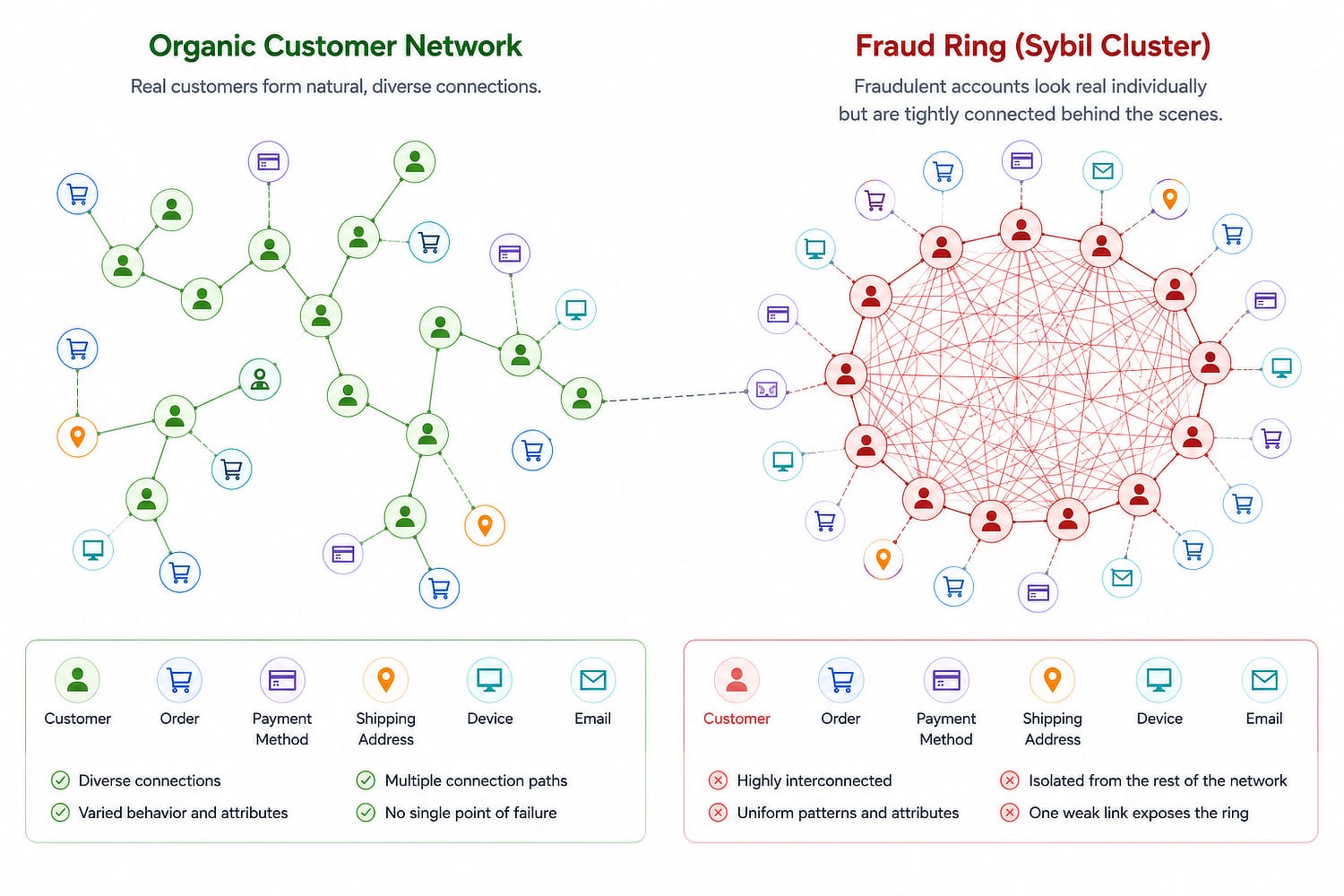
The first cluster resembles a household, workplace, or other naturally developed group. The second has features consistent with coordination. Neither conclusion is certain, but the difference gives investigators a useful way to allocate attention.
The response also depends on the product. A reputation system might reduce the weight of reviews or votes from a suspicious cluster. A fraud team might examine a group of purchases that shares devices and behavioral patterns. In both cases, the graph supplies context that individual events lack.
Quantifying Suspicion
Software needs numerical features rather than a visual impression of the graph. One simple feature is internal density, which measures how many possible connections within a group actually exist.
Asterism's full graph contains several types of nodes, so it cannot calculate account density directly from every edge. It first creates a projected account graph: two account nodes are connected when they share a sufficiently strong trait, such as a verified payment method, device fingerprint, or shipping address. The projection rules must be chosen carefully; sharing a common email provider would not be meaningful enough by itself.
Suppose a projected cluster contains ten accounts. Each account could connect to the other nine, but counting every connection twice would duplicate A→B and B→A. The maximum number of unique relationships is therefore:
\[\frac{10 \times 9}{2} = 45\]
If 36 of those 45 relationships exist, the cluster's internal density is:
\[\frac{36}{45} = 0.80\]
or 80%.
Density alone is not suspicious. A family or workplace can also be highly connected. Asterism combines it with other measurements:
- Internal Density: The fraction of possible account-to-account connections present in the projected graph.
- Behavior Similarity: How closely purchasing, browsing, and timing patterns resemble one another.
- Creation Concentration: How tightly account creation times are grouped.
- External Isolation: How few credible relationships connect the group to established accounts outside it.
For illustration, Asterism might combine those measurements into a Group Coordination Score:
\[\text{Group Coordination Score}
=
0.35(\text{Internal Density})
+
0.25(\text{Behavior Similarity})
+
0.25(\text{Creation Concentration})
+
0.15(\text{External Isolation})\]
Suppose a cluster has these measurements:
| Measurement | Score |
|---|---|
| Internal Density | 0.80 |
| Behavior Similarity | 0.90 |
| Creation Concentration | 0.85 |
| External Isolation | 0.95 |
The resulting score is:
\[0.35(0.80)
+
0.25(0.90)
+
0.25(0.85)
+
0.15(0.95)
=
0.86\]
The measurements, weights, and threshold are fictional. A production system would derive and validate them against its own data, costs, and acceptable false-positive rate. Even then, the score would not establish truth. It would provide a consistent way to rank groups for investigation.
At a high level, the process looks like this:
build a relationship graph from accounts, orders, devices,
payments, addresses, emails, and IPs

project an account graph using sufficiently strong relationships
groups = find candidate communities

for each group:
    internal_density = measure account connections
    behavior_similarity = compare activity patterns
    creation_concentration = measure creation timing
    external_isolation = measure credible outside connections

    coordination_score = combine the four measurements

    if coordination_score exceeds the review threshold:
        send the group for investigation
Real systems use more signals and validation than this example, but the purpose is the same: identify groups whose combined structure and behavior deserve review.
Making Fraud Expensive
Relationship analysis changes the economics of maintaining false identities.
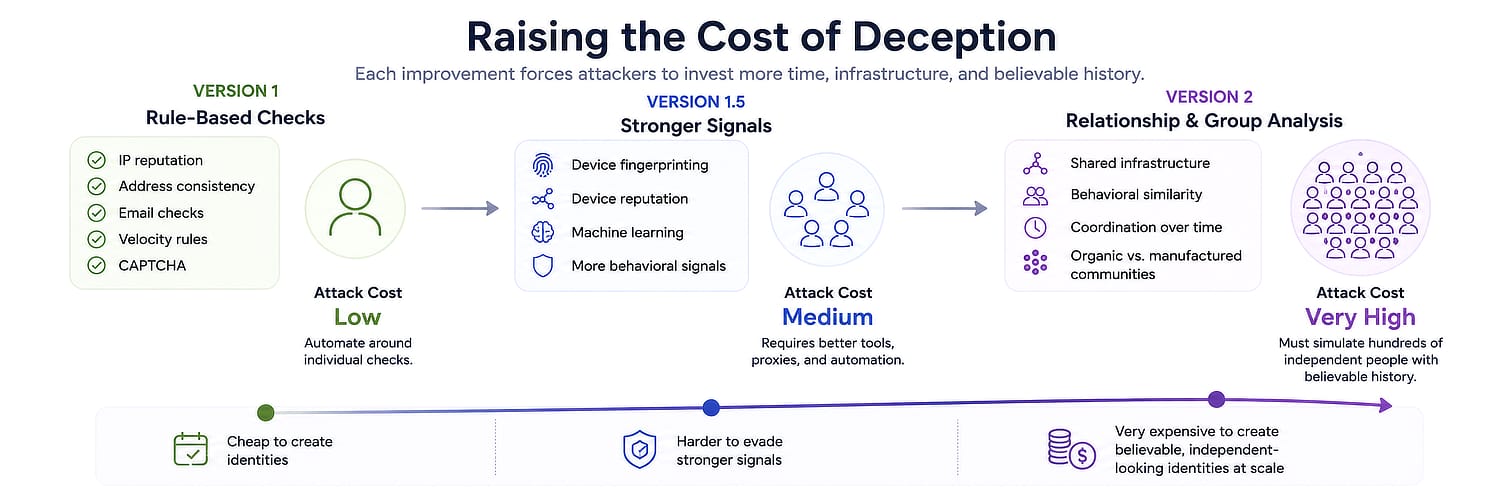
Creating an account is cheap. Maintaining hundreds of accounts with varied infrastructure, believable histories, realistic timing, distinct behavior, and credible relationships to established customers is harder. Each additional requirement increases the cost of making coordinated identities look independent.
The goal is not to make deception impossible. It is to make a large operation more expensive to sustain and more likely to expose shared structure.
Beyond Ecommerce
The same problem appears anywhere a system grants influence or benefits per identity:
- A product review platform must decide whether five-star ratings represent independent customers or one seller operating many accounts.
- A discussion forum must distinguish community sentiment from coordinated attempts to manufacture consensus.
- A referral program must determine whether ten customers joined or one person created ten accounts for ten rewards.
- An abuse reporting system must resist groups of accounts created to suspend a legitimate user or blocklist an innocent site.
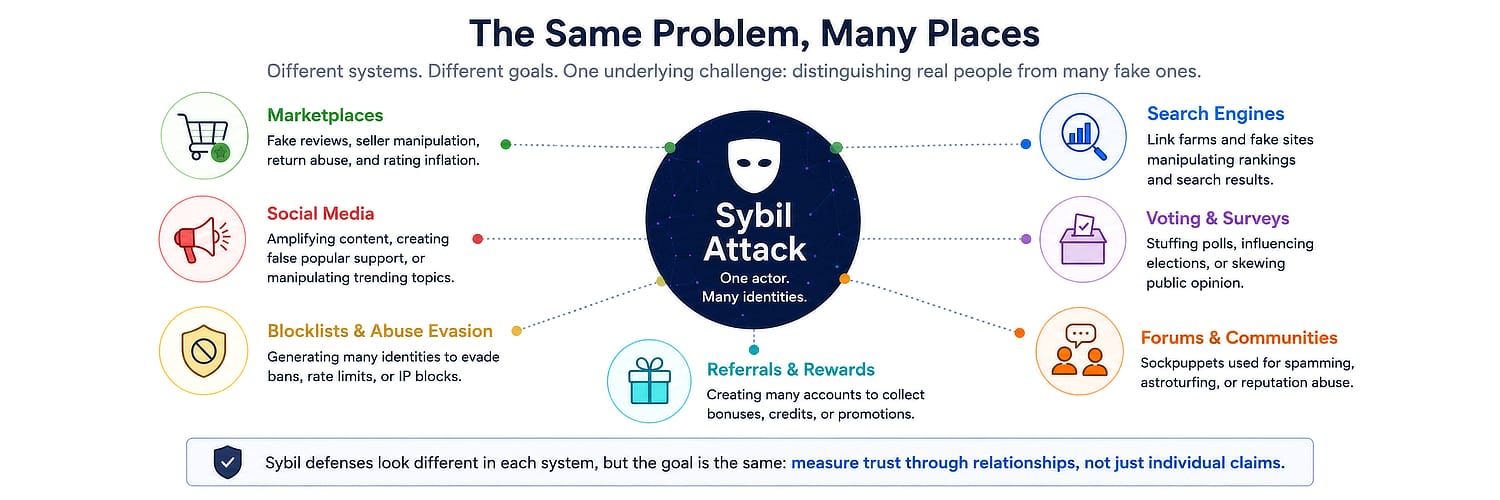
Search engines face a related challenge when networks of sites link to one another to manipulate rankings. The products and incentives differ, but each system must decide whether activity that appears independent is actually coordinated.
Looking at Relationships Instead of Events
A Sybil attack exploits the gap between identity and independence. Transaction-level checks can detect suspicious events, while relationship analysis can reveal that many ordinary-looking events belong to the same operation. Effective systems use both and treat their conclusions as evidence rather than certainty.
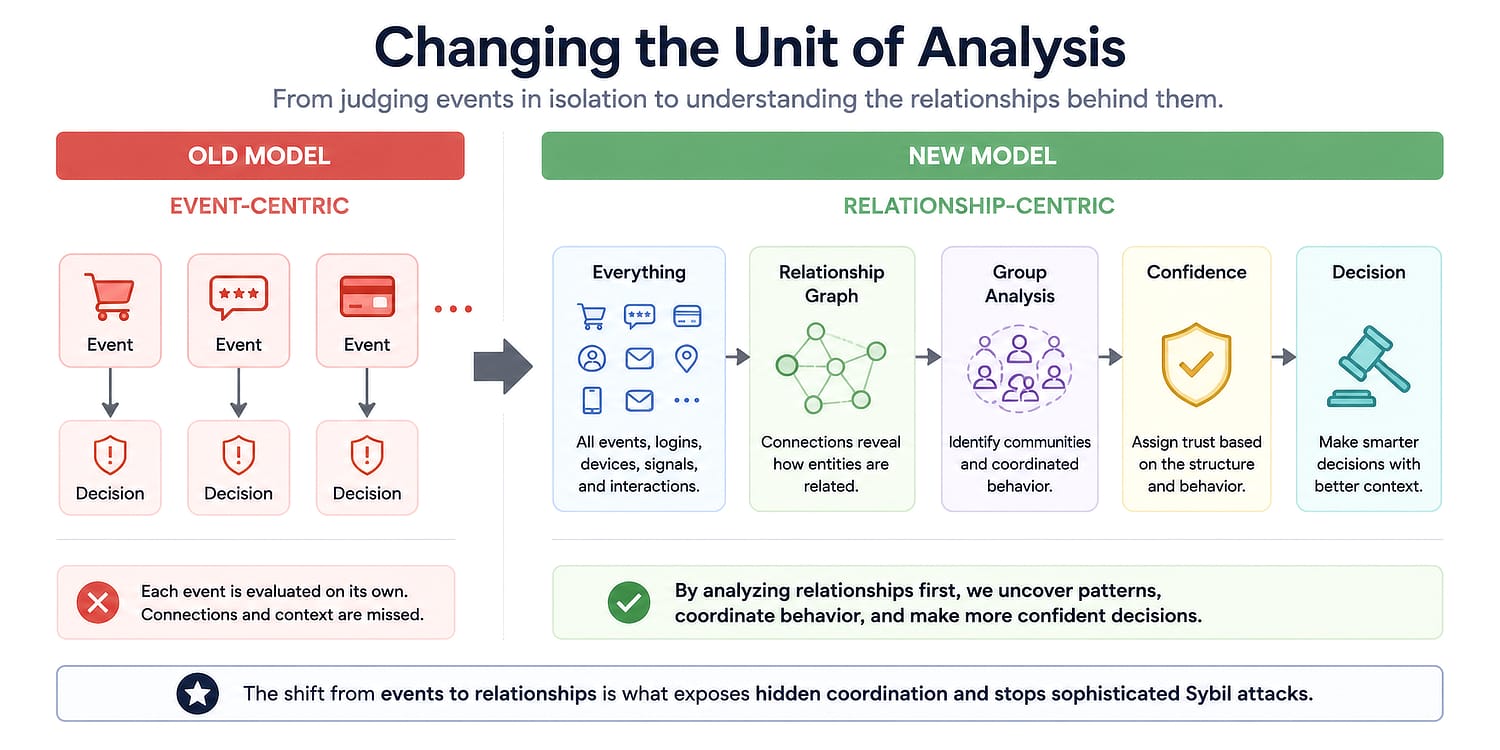
There is no perfect detector. The practical objective is to increase the cost of maintaining convincing false identities, identify coordinated behavior earlier, and send the strongest cases to people who can investigate them in context.
The lasting idea is simple: before trusting a crowd, determine whether it is actually a crowd.
- John R. Douceur, "The Sybil Attack", Proceedings of the First International Workshop on Peer-to-Peer Systems, 2002. back
- Haifeng Yu, Michael Kaminsky, Phillip B. Gibbons, and Abraham D. Flaxman, "SybilGuard: Defending Against Sybil Attacks via Social Networks", ACM SIGCOMM, 2006. back
- Lorenzo Alvisi, Allen Clement, Alessandro Epasto, Silvio Lattanzi, and Alessandro Panconesi, "SoK: The Evolution of Sybil Defense via Social Networks", IEEE Symposium on Security and Privacy, 2013. back